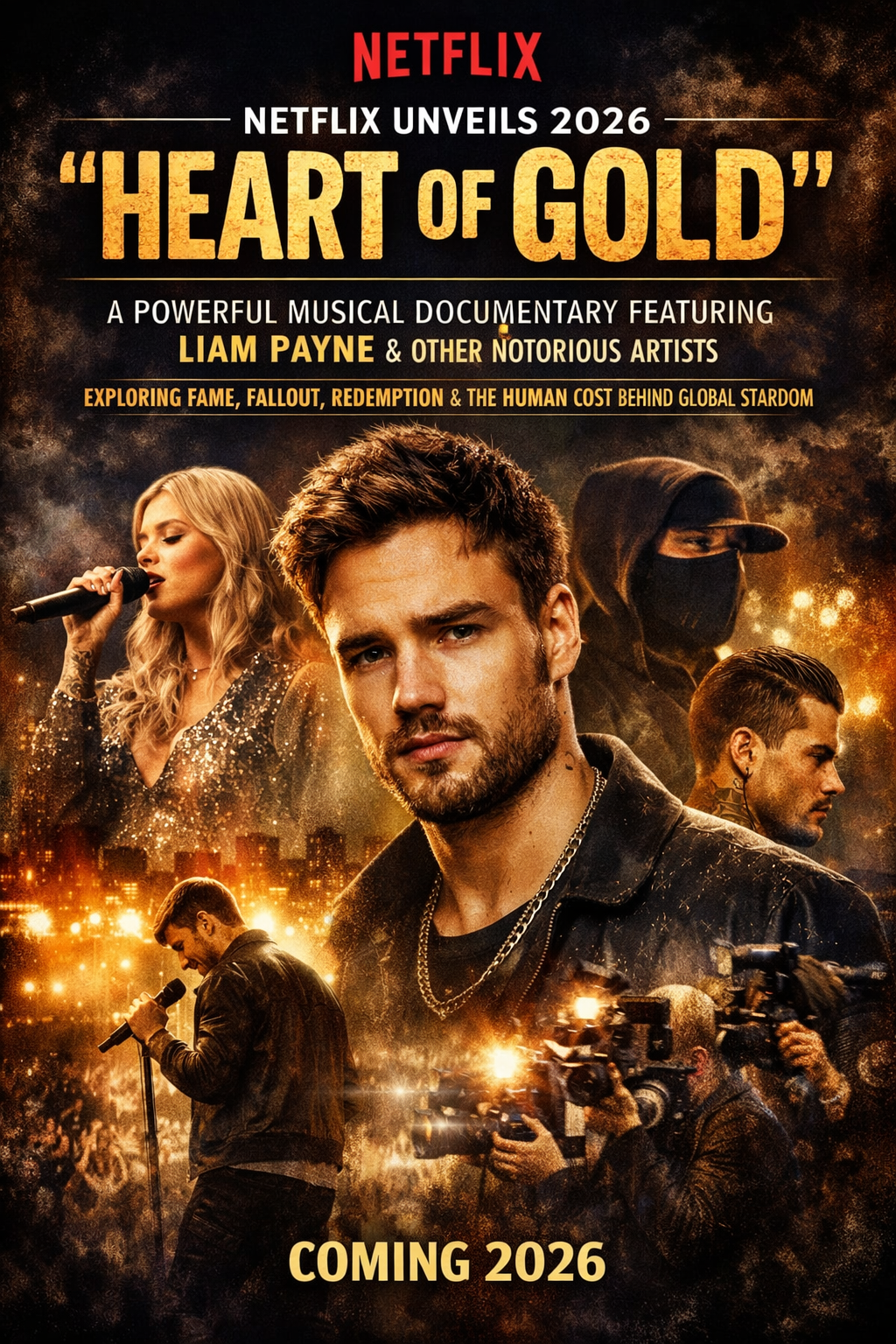
Netflix Release 2026: Heart of Gold
In 2026, Netflix is set to unveil one of its most emotionally ambitious music-centered projects to date with Heart of Gold, a powerful documentary feature that places vulnerability, legacy, and redemption at the center of global stardom. Featuring Liam Payne alongside a carefully curated group of other notorious and influential artists, the film promises to go far beyond a traditional music documentary. Instead, it positions itself as a human story about fame’s cost, creative survival, and the quiet moments that define who artists really are when the lights fade.
Heart of Gold is described by insiders as an intimate, cinematic exploration of the modern music industry’s emotional landscape. At its core is the idea that behind every chart-topping hit and sold-out arena lies a complex inner world shaped by pressure, expectation, public judgment, and personal struggle. Netflix’s vision for the film is not to glorify excess or controversy, but to confront it honestly, allowing audiences to witness both the brilliance and the bruises that come with living life at the center of attention.
Liam Payne’s presence anchors the documentary with particular emotional weight. Having risen to global fame at a young age, his journey reflects the central themes of Heart of Gold: early success, identity confusion, reinvention, and maturity. The film reportedly follows Payne through candid conversations, reflective moments, and creative sessions that reveal how fame reshapes relationships, mental health, and self-worth. Rather than presenting a polished narrative, Heart of Gold allows space for uncertainty, growth, and self-examination.
What elevates the project further is its ensemble approach. Alongside Payne, the documentary features other notorious artists from different genres and backgrounds—figures known not only for their musical impact but also for their complex public narratives. These artists are not framed as cautionary tales or heroes, but as multidimensional individuals navigating the same emotional terrain in different ways. Their stories intersect through shared experiences of scrutiny, artistic pressure, and the constant demand to remain relevant in a fast-moving industry.
Visually, Heart of Gold is expected to adopt a refined, cinematic style. Netflix has leaned into atmospheric lighting, intimate close-ups, and restrained pacing to create a tone that feels reflective rather than sensational. Concert footage is used sparingly, serving as contrast to the quieter scenes—hotel rooms, studio spaces, late-night conversations—where the artists’ guard is lowered. The result is a film that feels personal, almost confessional, without becoming intrusive.
The title Heart of Gold carries symbolic weight throughout the documentary. It speaks to the idea that beneath hardened exteriors, controversies, and public personas, many artists retain a deep sense of empathy, passion, and vulnerability. The film repeatedly returns to this theme, suggesting that resilience in the music world is not about emotional numbness, but about learning how to protect one’s inner self while continuing to create.
From a cultural standpoint, Heart of Gold arrives at a time when audiences are increasingly drawn to authenticity. Viewers no longer want mythologized celebrities; they want honesty, nuance, and emotional truth. Netflix appears keenly aware of this shift, positioning the documentary as a conversation rather than a statement. It does not offer simple answers about fame or success, but invites viewers to sit with complexity and contradiction.
Music itself plays a crucial role in the narrative. Original compositions, stripped-down performances, and reimagined versions of familiar songs are woven into the storytelling, often serving as emotional punctuation. Rather than functioning as background, the music reflects the artists’ internal states—regret, hope, anger, gratitude—at different points in their journeys. In several moments, the songs speak where words fall short.
Industry observers believe Heart of Gold could become one of Netflix’s most talked-about music releases of 2026. Its appeal stretches beyond fans of the featured artists, resonating with anyone interested in mental health, creativity, and the human side of ambition. The documentary does not rely on shock value; instead, its power lies in sincerity and restraint.
Ultimately, Heart of Gold is less about fame and more about humanity. It challenges the audience to reconsider how artists are perceived, consumed, and judged. By centering emotional truth and personal reflection, Netflix delivers a film that feels timely, compassionate, and quietly profound. When it premieres in 2026, Heart of Gold is poised to leave a lasting impression—not as a spectacle, but as a mirror held up to the modern age of celebrity.